ProView – C.A.M.P. Reel Review
The world of personal tethers and lanyards has taken a crazy leap forward in the recent past. Yet, the idea of a personal anchor is about as old as climbing itself. The front cover of my copy of “Yosemite in the Fifties” shows George Whitmore jugging (on prusiks!) with some sort of rudimentary PAS. Warren Harding improvised something of this sort when he spent 47 days climbing the Nose in 1958.
C.A.M.P. Reel
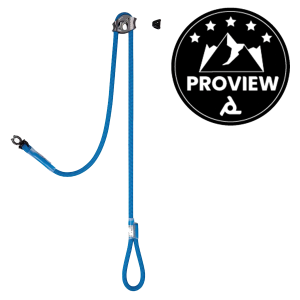
Product Name: C.A.M.P. Reel
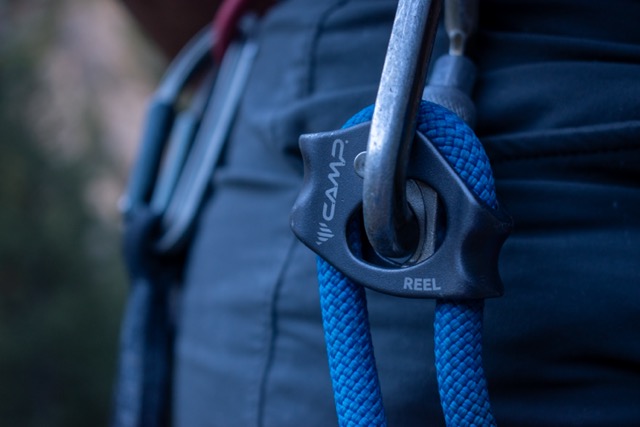
Product Description: This quick-adjust positioning lanyard from C.A.M.P. is particularly compact. It's also lightweight and easy to use. An innovative mobile cam makes it easy to operate with one hand.
Offer price: $70 MSRP
-
Quality
(5)
-
Features
(4)
-
Durability
(4)
Summary
I tested the reel in all sorts of conditions. I work as a climbing guide on the Front Range, so I used the device every day for work. While guiding, a PAS is a critical positioning device – it allows me to move around the anchor and adjust my position to better see and attend to my clients.
Overall
4.3Pros
- Far superior camming action makes extension and retraction much easier
- Releasable under load!
Cons
- Bulky 9.4mm rope gets in the way
- Self-attachment clip is underwhelming
Fast forward to the mid-1980s and the daisy chain becomes popular. Originally (and still today) used primarily for aid climbing, the daisy chain can be used in combination with a fifi hook. The fifi attached to your harness, and the daisy chain – with its multiple loops – then can act as a progress capture system as a climber steps higher in their ladders.
30 years later and the sport climbing revolution has matured. The mid-2010s saw a flurry of new devices intended to replace traditional daisy chains: Petzl Evolv Adjust (single), Petzl Connect Adjust, Petzl Dual Connect Adjust, Black Diamond Link PAS, CAMP Swing (the Reel isn’t their first iteration!), Petzl Dual Evolv Adjust, Edelrid Switch Adjust, Edelrid Switch Adjust Double… the list goes on!
These devices primarily aimed to solve two problems. First, adjustability. The fifi system is great, but it requires two different items: the fifi and the daisy chain. Furthermore, it’s only adjustable between each “step” of a different loop, and it requires one to temporarily detach to adjust it! The manufacturers of daisy chains or fifi hooks will generally tell you that the devices are not intended for “life support.” I.e. you should not (per their guidelines) solely rely on it to keep you safe.
Secondly, this new slate of devices that appeared 10-15 years ago generally all have a dynamic element to them. Fifi hooks and daisy chains are subject to the same problem as a sling on a harness with a locker – they’re static. Taking a factor two fall onto a sling or daisy chain won’t just hurt – it can also break dyneema slings. Most of these modern personal anchors use dynamic climbing rope – helping to mitigate this issue.
So, with so many devices to choose from, how can one compare? For the purpose of this review, I’ll pick the devices that are the most similar – those that:
- Are intended to adjust with one hand
- Incorporate some sort of dynamic element
- Are the “single” version (i.e. not the Dual Connect Adjust, but the Connect Adjust)
Performance
I tested the reel in all sorts of conditions. I work as a climbing guide on the Front Range, so I used the device every day for work. While guiding, a PAS is a critical positioning device – it allows me to move around the anchor and adjust my position to better see and attend to my clients.
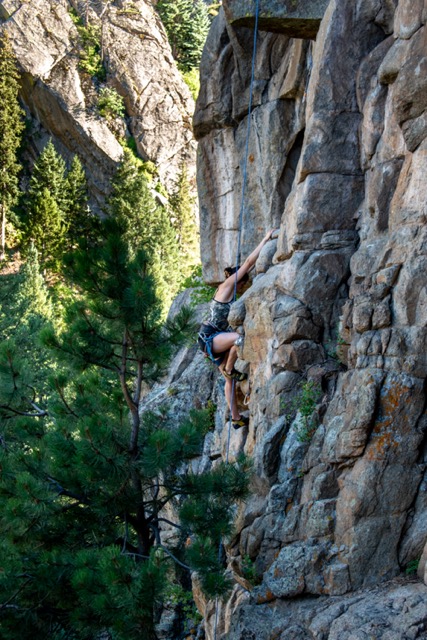
Additionally, I used the Reel to Lead Rope Solo (LRS), Top-Rope Solo (TRS), and aid climb. My choice to incorporate these disciplines was driven by the fact that the Dual Connect Adjust is far and above the most common personal anchor that is used in Yosemite Valley. Climbers will typically replace the dynamic 9-10mm rope with skinny ~5mm cord, but we won’t discuss that here. So, I wanted to see how it performed in the aid climbing and soloing worlds.
There is really only one big thing to talk about in terms of performance – the camming unit. Other devices strictly use geometry to accomplish the movement. Every PAS should completely stop motion to elongate when weighted, in addition to being adjustable. CAMP’s innovation is to use camming action to actuate this two-fold requirement. The result? A device that is much, much easier to handle and is releasable under load!
First, the ease of movement. Most modern PAS devices (including the Reel) require one to tilt their hand away from the harness and “push” the metal part away from their body. The rope moves through the device and thus elongates it. The camming action makes a HUGE difference in how difficult this is (I attempted to use a force meter to measure, but that didn’t work well). The Petzl Connect Adjust is probably twice as difficult to move in both directions – both in and out. When you compare the two side-by-side, it feels the CAMP reel just zips back and forth.
Second, the Reel is releasable under load. The most annoying part of this when aid climbing (and during LRS and TRS) is realizing you’d like to be lower, but you’re at a hanging stance. When using the Connect Adjust, you have to find some way to take the weight off the device (standing in a sling, pulling up on something, etc) before you can make the device longer. When using the Reel you have to use a “two part” motion. First, you pull on the tail to orient the cam, second, you tilt the cam body towards the “loose” end. This “two part” motion is the same trick to help release the Petzl Connect Adjust under load – the only difference is that it works.
Look/Style
Not a ton to say here – it’s blue! It’s nice that CAMP made this a different color from competitors – it makes it easy to differentiate in a pile of gear. Other than that, it’s not as if there’s a choice of styles or patterns.
Fit/Comfort
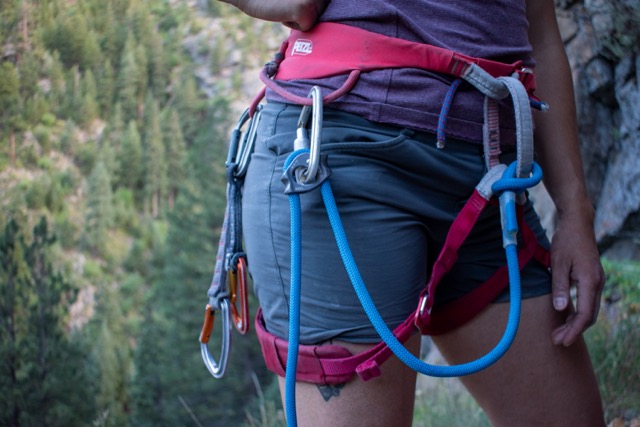
The Reel is certainly a one-size-fits all product. It has adjustable lengths from 15-100cm, which is common across all devices in the category. The only real notable difference comes in with how the device attaches to the harness.
Both CAMP and Petzl recommend girth-hitching the devices around the belay loop – not through the hard points. That said, I see recreational climbers attaching these devices through their hard points ~90% of the time. I assume this is largely due to the “fabric in hard points, metal on belay loops” dogma that has been commonly taught for quite some time.
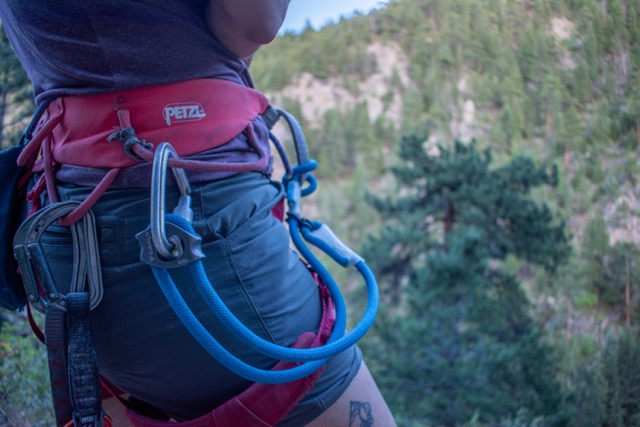
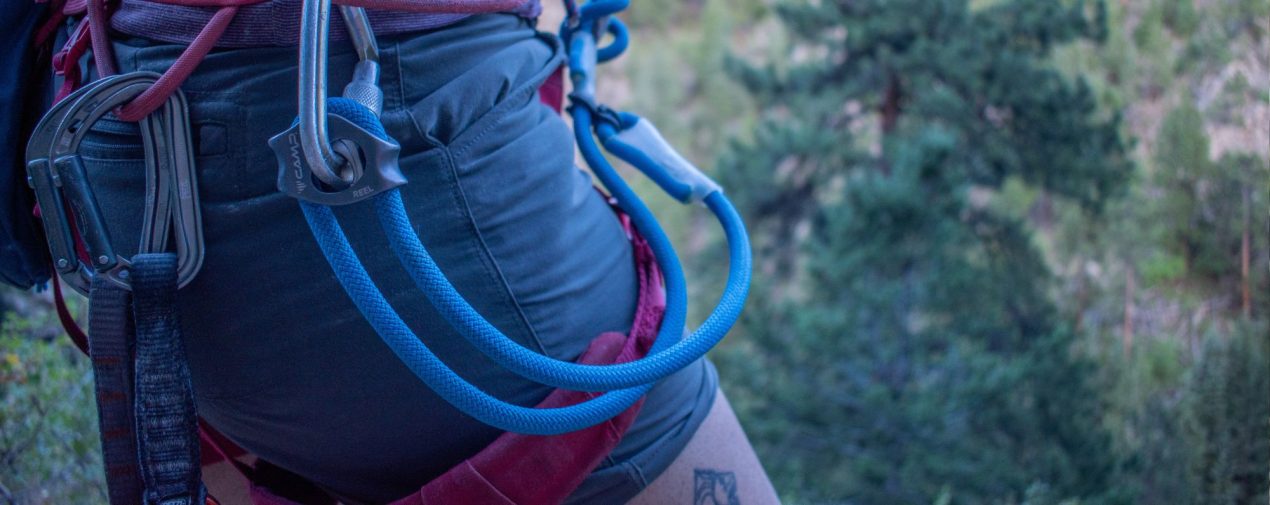
The CAMP Reel uses 9.4mm Shadow Dry rope which is quite bulky! The Petzl Connect uses 9.0mm rope – but the attachment style is quite different. The new(ish) Petzl Connect features a length of dyneema stitched to the end of the rope – where you would attach it. This means that you simply have to girth hitch a length of dyneema to your harness. Compared to using 9.4mm rope the difference is night and day. It’s certainly more ergonomic, comfortable, and less bulky to use the Connect in this manner as compared to the Reel.
Weight/Packability
I was originally going to include a table of weights for various devices in this review – but they’re all practically the same. The difference between the lightest on the market and the heaviest on the market is only about 25g (~1 oz), so it’s really not a selling point in either direction.
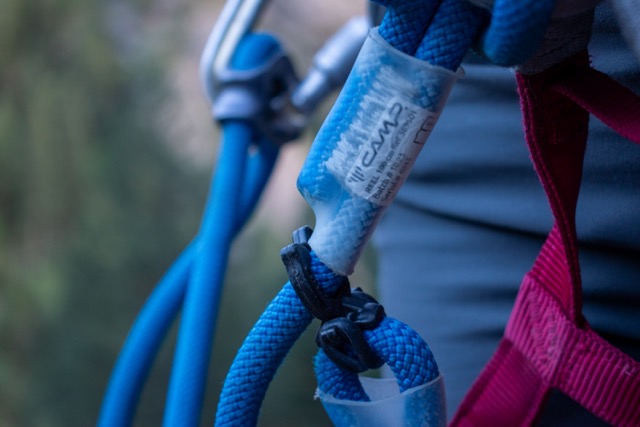
Packability, though, is something we should discuss. The Reel includes a tiny black clip on the far end of the device that allows it to clip back to itself (or a harness). CAMP markets this as a way to deal with the pesky end of the device that just hangs and swings freely.
Honestly, I tried to like this feature. I tried hard to use it. I couldn’t find a single time in which it came in handy. If it is clipped to the rope and you extend it, it comes undone. If you clip it to your harness, you have to either unclip it or rip it off. I’m willing to believe that someone, somewhere, will like this feature, and it has never gotten in the way, so it’s at least neutral.
Durability/Construction
I own a few different dynamic-rope based PAS devices, and I’ve had them for years. The limiting factor is the rope itself, which can be replaced. We will not discuss that topic here because, done incorrectly, it can void the warranty of some of these devices.
The black attachment clip is probably the first thing to break on this. Mine didn’t break and I’ve been wearing it on my harness for a few months. I can’t find evidence that CAMP sells the part separately, but I would guess a nice email to customer support could fix the problem.
Friendliness to the Earth
Similar to many outdoor brands, CAMP seems to have made a commitment to eco-friendliness. Whether that translates to legitimate changes, we won’t know for some time.
In October 2023, CAMP launched its ESG (Environmental, Social, and Governance) initiative called “Responsible Evolution.” This program “underscores the company’s commitment to sustainable practices across five key areas: Governance, People, Community, Environment, and Products.” There isn’t much information about what exactly this will entail or what CAMP has done since then publicly available, but it’s a start!
The Final Word
If CAMP comes out with a dyneema-style attachment system, it would render the Petzl Connect Adjust obsolete. The camming action is a far superior mechanism that makes shortening and extending (including under load) much easier. In a world of many, many copycat devices, the Reel is distinct!
Shop the C.A.M.P. on Outdoor Prolink. Not a member? Apply today
See other C.A.M.P. reviews
About the Gear Tester

Patrick O’Hare
Patrick O’Hare is a Senior Climbing Guide at Front Range Climbing Company. He has been working in outdoor education for eight years and loves helping individuals progress in their climbing careers. You can keep up with his climbing and photography @pjophoto.
- Patrick O’Hare
- Patrick O’Hare

- Patrick O’Hare
- Patrick O’Hare

- Patrick O’Hare

- Patrick O’Hare
- Patrick O’Hare

- Patrick O’Hare
- Patrick O’Hare

- Patrick O’Hare

- Patrick O’Hare
- Patrick O’Hare

- Patrick O’Hare

- Patrick O’Hare